Download:
Abstract
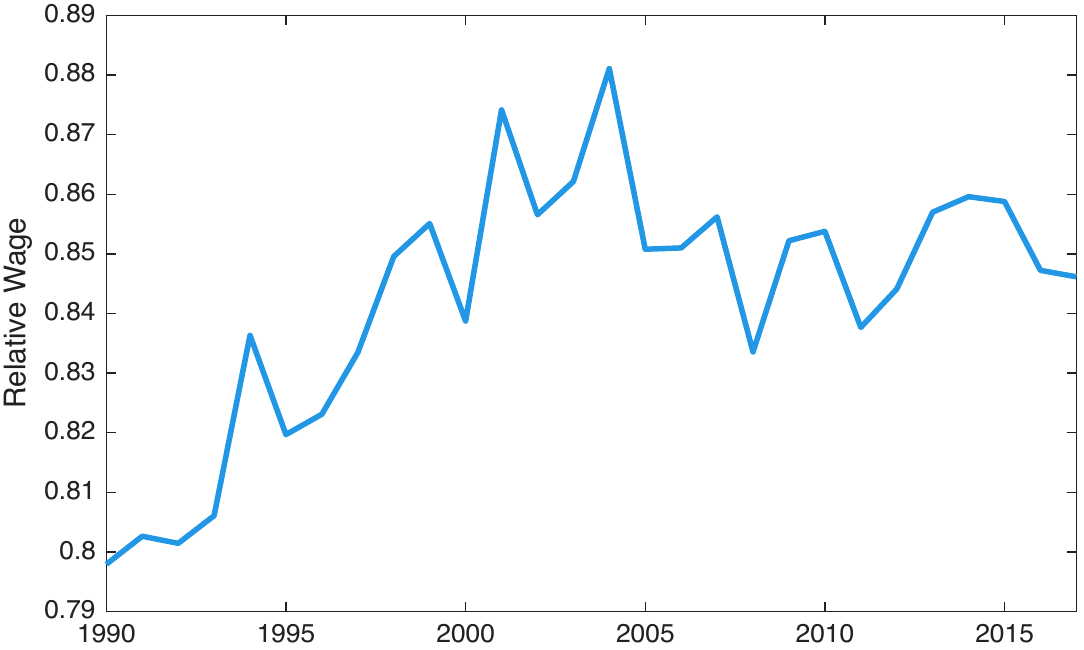
Japan has faced rapid ageing, persistently low interest rates, sluggish growth, and deflation for decades. Concurrently, there has been a gradual convergence in productivity between young and elderly workers. This paper aims to explore the relationship between productivity, demographic shifts, and interest rates in Japan during the post-bubble era, using an overlapping generations two-agent New Keynesian (OTANK) DSGE model. The narrowing productivity gap between younger and older cohorts puts upward pressure on interest rates. Meanwhile, factors such as longer life expectancy and negative population growth rates exert downward pressure on interest rates. The latter effect dominates. A central bank that does not account for this when setting monetary policy may induce deflationary pressure in the economy. Important policy implications emerge: Enhancing worker productivity across workers’ entire life-cycle and bridging the productivity gap between younger and older workers can help offset the decline in interest rates, and monetary policy ought to account for shifting demographics.
Relative Wages: Young and Old Workers
Seminars and Presentations
2024: Japanese Economic Review special issue on “Macroeconomics and Heterogeneity”, University of Portsmouth (Royal Economic Society PhD Conference), National University of Singapore (Dynare Conference)
Citation:
Komatsu, M., Murakami, D. & Shchapov, I., “Productivity over the Life-Cycle and its Effect on the Interest Rate”. Japanese Economic Review 76, 429–461 (2025). https://doi.org/10.1007/s42973-025-00192-x