Download
Abstract
In this paper we study the interaction between monetary policy and financial inclusion in an economy that introduces a central bank digital currency (CBDC). Using a New Keynesian two-agent framework with banked and unbanked households, we show that CBDCs provide a more efficient savings device for the unbanked to smooth consumption, increasing welfare. A Ramsey optimal policy exercise reveals that the CBDC rate is set at a constant spread to the policy rate. We observe a policy trade-off: a higher CBDC rate benefits the unbanked, but disintermediates banks and reduces welfare of banked households. Taken together, our findings highlight the role of tailoring CBDC design based on the level of financial inclusion in an economy.
Welfare Comparison (CBDC Economy %ch. over no-CBDC Economy)
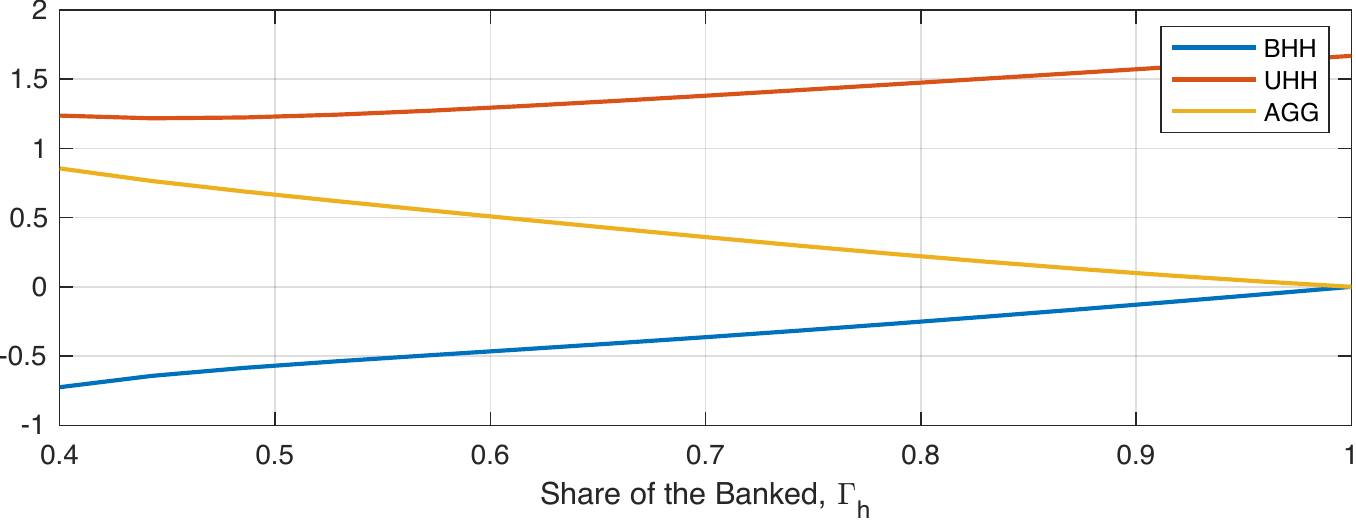 Figure plots welfare for the banked (BHH), unbanked (UHH) and aggregate households as a function for the share of the banked population. The welfare is calculated as a percent change from the regime with no CBDC.
Seminars and Presentations
2022: UWA Blockchain and Cryptocurrency Conference
2023: University of Oxford (internal seminar), University of Pavia (internal seminar), University of Warwick (internal seminar), Bocconi University (internal seminar), IP Paris/CREST (internal seminar), Barcelona Graduate School of Economics (EEA-ESEM Conference), University of Warsaw (Warsaw MMF Conference), Central Bank of Malta (Dynare Conference), Federal Reserve Board (Economics of Payments XII Conference)
Citation
Murakami, David and Shchapov, Ivan and Viswanath-Natraj, Ganesh, CBDCs, Financial Inclusion, and Optimal Monetary Policy (May 6, 2022). Available at SSRN: https://ssrn.com/abstract=4102397 or http://dx.doi.org/10.2139/ssrn.4102397 .