Download:
Abstract:
This paper asks whether a floating exchange rate insulates a financially open economy from US monetary and financial shocks. State-dependent local projections on monthly Korean and US data for 1999–2019 show that, when US financial conditions are strained, a US monetary tightening depresses Korean export and output growth later and for longer than in calm times, despite a sharp depreciation of the won. I build a two-country New Keynesian model of Korea and the United States in which each country’s banks face an occasionally binding leverage constraint, and I estimate it on quarterly data with a piecewise linear Kalman filter. A US tightening depreciates the won. Because Korea is a net dollar borrower, the depreciation raises the won value of bank debt and tightens Korean banks’ constraint. At the posterior mode a float mitigates this balance sheet channel but cannot eliminate it: a US tightening that raises the US corporate spread as much as it rose in 2008 binds both countries’ constraints even under a float. In stochastic simulations driven by US monetary shocks, the frequency of such global crises barely depends on the exchange rate rule, while Korean-only stress rises with exchange rate management. Shocks to the price of dollar funding bind the Korean constraint alone, about as often under a float as under the estimated rule, but exchange rate management makes that stress far deeper. The Trilemma survives, but as a statement about domestic stress rather than global crises.
Responses to a Stress-Sized US Monetary Policy Shock at the Posterior Mode
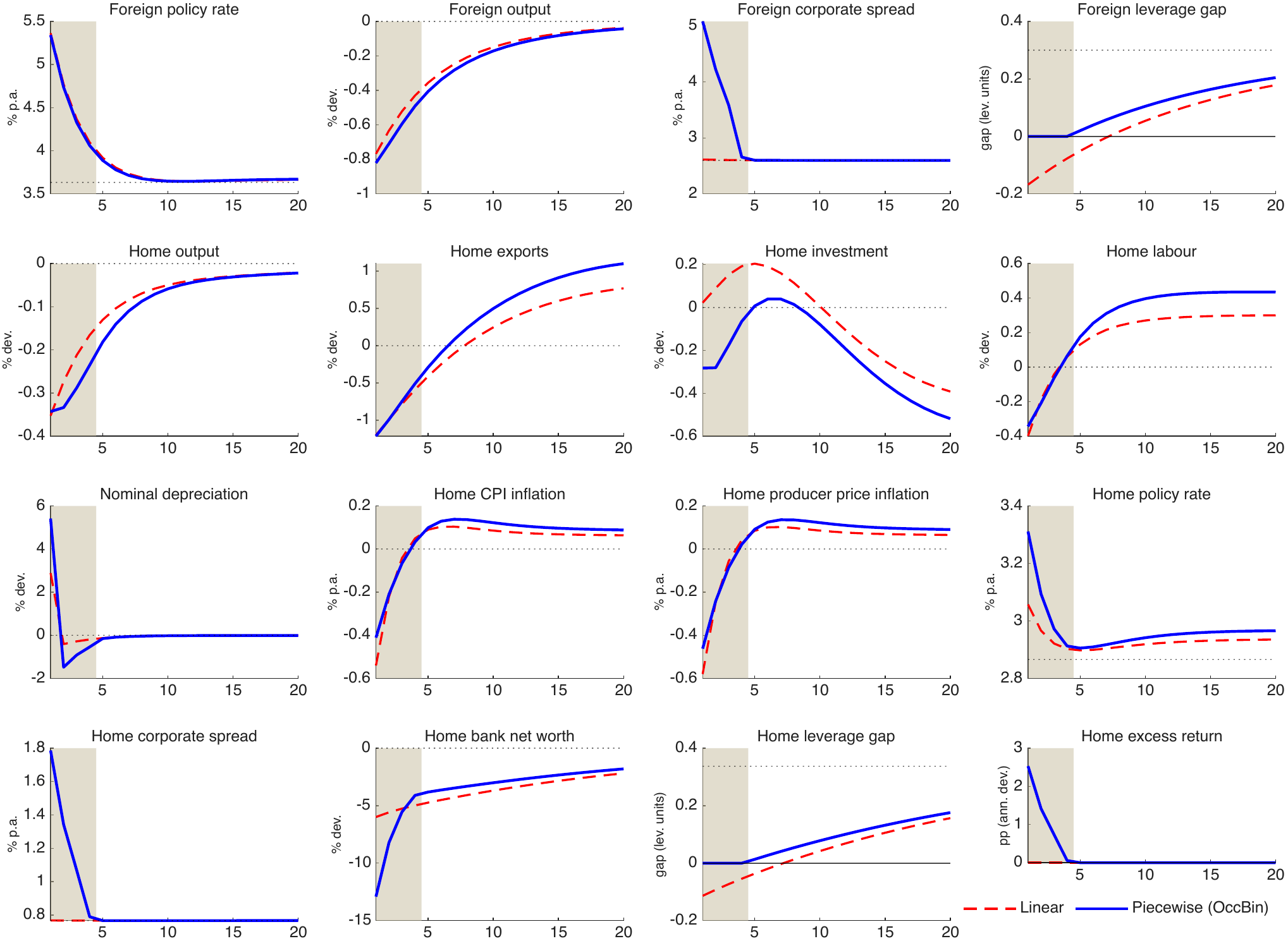
Impulse responses to a US monetary policy shock of 4.7 posterior standard deviations, the size at which the US corporate spread rises by 2.5 percentage points on impact, as between 2008Q2 and 2008Q4 (a rise of 1.7 percentage points in the annualised Foreign policy rate on impact), evaluated at the posterior mode under the estimated Home policy rule ($\phi_E=0.22$). Solid blue lines: piecewise linear (OccBin) solution in which both incentive compatibility constraints may bind; dashed red lines: linear solution in which neither binds; dotted black lines: steady state. Shaded quarters (1–4) are those in which both the Home and the Foreign constraint bind. Quantities are percentage deviations from steady state; rates, inflation, and spreads are annualised percentage points; leverage gaps are in leverage units. Horizon in quarters.
Seminars and Presentations
2021: University of Oxford (internal seminar)
2023: University of Pavia (internal seminar), London Business School (Transatlantic Doctoral Conference), University of Oxford (IFABS Conference)
2025: Bank of England
2026: CIGS Conference on Macroeconomic Theory and Policy (Tokyo)
Citation:
Murakami, David, Gone with the Wind: Monetary Policy and the Global Financial Cycle (12 November 2026). Available at SSRN: https://ssrn.com/abstract=4198695 or http://dx.doi.org/10.2139/ssrn.4198695